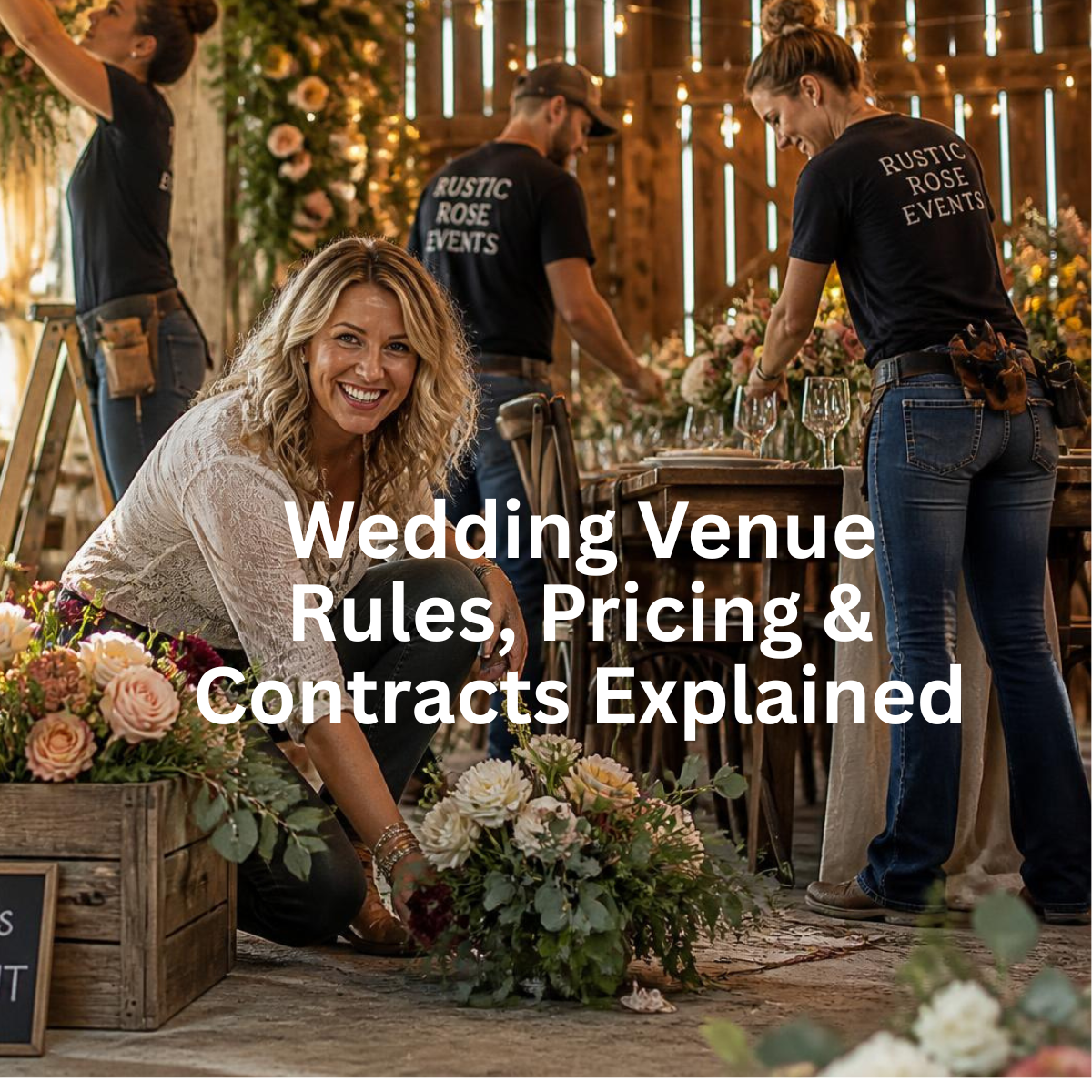
100 Honest Answers About Venue Rules, Pricing, Contracts & Booked Weddings
Whether you own a wedding venue, dream of opening one, are planning a wedding, work in the wedding industry, or simply want to better understand how venues operate, there is often much more happening behind the scenes than guests ever see. Wedding Venue Rules, Pricing & Contracts Explained offers a closer look at why venues make certain decisions, what it actually takes to operate these unique small businesses, and how contracts, policies, pricing, property care, safety, vendors, and future weddings all fit together. The goal isn’t to suggest that venues are always right, it’s to add context to conversations that are often far more complicated than they appear online.
Spend enough time on social media and eventually you will see some version of:
“Wedding venues are a scam.”
“Why does everything cost more as soon as you say the word wedding?”
“The venue wouldn’t give them their money back.”
“The venue had ridiculous rules.”

Sometimes, criticism is deserved. Wedding venues are businesses, and businesses should be accountable for what they promise, how they communicate, and how they treat people. But there is another side of the wedding venue story that rarely fits into a 30-second outrage video.
Many wedding venues are locally owned small businesses operated by families, couples, farmers, entrepreneurs, and very small teams. They don’t necessarily want 300 weddings every year. Many would be thrilled to host 50, 75, or 100 exceptional weddings, protect their property, pay their employees, serve couples well, maintain their reputation, and still have a sustainable life outside the business.
Texas alone was estimated to have roughly 175,000 weddings in 2025. Those weddings are spread across an enormous state, many price points, hotels, resorts, churches, event centers, ranches, restaurants, country clubs, destination properties, and independently owned wedding venues.
A small venue doesn’t need every wedding.
It needs the right number of weddings at a sustainable price, with expectations everyone understands before the contract is signed.
And there is one responsibility of a wedding venue that is almost invisible to the public.
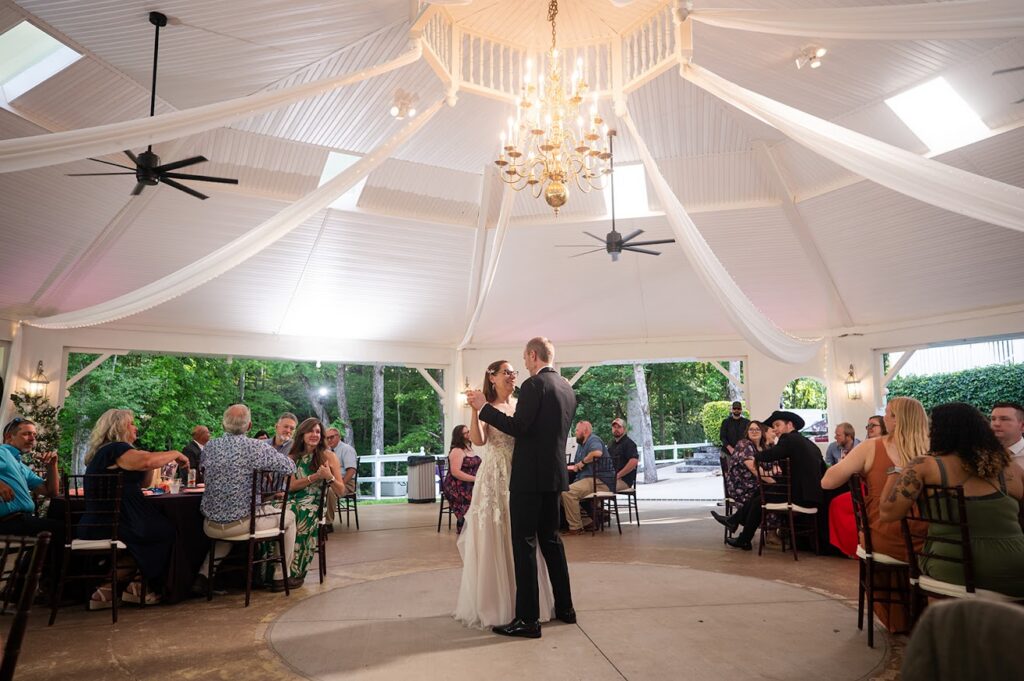
The Future Wedding Principle
A wedding venue has an obligation not only to the couple getting married today.
It also has obligations to:
- the couple getting married tomorrow;
- the couple arriving next Saturday;
- the couple who toured six months ago and fell in love with the property exactly as they saw it;
- employees who need a safe workplace;
- vendors who expect a functional venue;
- neighbors and local communities;
- insurers and regulatory agencies;
- and every future couple who has already trusted that venue with one of the biggest days of their lives.
That means a venue sometimes has to say no today so it can keep a promise it already made to someone else tomorrow.
That isn’t always fun.
It isn’t always popular.
And it certainly doesn’t make for a sympathetic viral video.
But understanding this one principle explains a surprising number of wedding venue rules.
Here are 100 questions worth asking before deciding that a wedding venue policy is unreasonable.
Dawn, owner of The Enchanted Point wedding venue offered this insight, “This topic really resonated with me as a fellow wedding venue owner, especially with all of the recent social media conversations about “wedding tax” and whether the wedding industry is a scam. I recently shared my own perspective on this subject from our experience at The Enchanted Point” https://theenchantedpoint.com/wedding-blog/f/is-the-wedding-industry-a-scam, The Enchanted Point is located about an hour south of Dallas, DFW Texas, 1511 Ovilla Road, Waxahachie, Texas 75167.
I hope couples will read both perspectives. Asking questions about pricing, policies, contracts, and what is actually included is a GOOD thing. The more transparent venues are and the more informed couples are, the better experience everyone can have.
Wedding Venue Rules: Why Are There So Many?
1. Why do wedding venues have so many rules?
Because a venue is managing hundreds of people, alcohol, vehicles, vendors, expensive property, weather, food, electricity, fire safety, noise, staffing, cleaning, insurance, and more—often simultaneously.
Many rules exist because something has gone wrong before.
2. Why can’t venues just make an exception for one couple?
Sometimes they can.
But an exception can create property damage, additional liability, staffing problems, licensing issues, or an expectation that the venue must make the same exception for everyone else.
3. Why does the venue care what happens if it’s our wedding?
Because it is your wedding and their property, employees, licenses, insurance, and business.
Both realities can exist at the same time.
4. Why can’t a venue simply say yes and keep the couple happy?
Because today’s easiest “yes” can become tomorrow’s enormous problem.
Responsible hospitality isn’t always saying yes. Sometimes it means protecting everyone from a problem before it happens.
5. Aren’t venue rules just designed to make things easier for the owner?
Some certainly make operations easier—and that’s not automatically unreasonable.
Clear procedures help hundreds of people move through a property safely and consistently.
6. Why can’t every wedding have completely different rules?
Customization and operational standards are different things.
A venue can customize the wedding experience while keeping consistent rules around safety, alcohol, access, property protection, staffing, and cleanup.
7. Why are some venue owners strict about seemingly tiny things?
Because a tiny problem multiplied by 75 weddings can become a very large problem.
8. Why do venues change rules over time?
Often because experience teaches them something.
The oddly specific rule in your contract may exist because of an oddly specific disaster three weddings ago.
9. Does having rules mean a venue isn’t customer-friendly?
No.
Some of the most caring businesses have strong boundaries precisely because those boundaries allow them to deliver consistently.
10. Should couples ask why a rule exists?
Absolutely.
A good venue should usually be comfortable explaining the reasoning behind an important policy.

The Most Important Customer You Don’t See: The Next Couple
11. Why should my wedding be affected by somebody else’s future wedding?
Because the venue has already made promises to those couples too.
Your wedding deserves a beautiful, functioning property—and so does theirs.
12. What does “protecting future weddings” actually mean?
It means protecting the building, landscaping, furnishings, dressing suites, equipment, staff, licenses, neighbors, reputation, and ability to remain open.
13. Why would one wedding really jeopardize another?
Imagine major property damage on Saturday when another couple arrives the following Friday.
There may be very little time to repair what happened.
14. Why are venues so protective of furniture and décor?
Because those things may be part of what future couples toured, photographed, loved, and paid to use.
15. Why does the venue care if something looks a little worn afterward?
Because the next couple may reasonably expect the venue to resemble what they were shown when they booked it.
16. Isn’t normal wear and tear part of running a venue?
Absolutely.
Intentional misuse, preventable damage, extreme messes, and ignoring property policies are different from reasonable wear.
17. Why can’t the venue simply repair damage afterward?
Sometimes it can.
But repairs require money, contractors, replacement materials, availability, and—most critically—time before the next wedding.
18. Doesn’t the damage fee solve the problem?
Money does not instantly restore a property.
A reimbursement on Monday doesn’t guarantee that a contractor can repair a damaged room before Friday’s rehearsal dinner.
19. Why does a venue care so much about preventing problems instead of just charging afterward?
Because prevention protects the experience of the people who come next.
20. Is the next wedding really part of the venue’s responsibility?
Absolutely.
One of the greatest responsibilities of a wedding venue is protecting today’s celebration without compromising tomorrow’s.
Dressing Suites, Spray Tans, Food, Drinks & “Why Can’t We Just…?”
21. Why would a venue prohibit spray tans in a dressing suite?
Because spray-tan residue can transfer onto walls, upholstery, linens, floors, furniture, and other surfaces that may be difficult or impossible to restore immediately.
22. But what if nobody plans to damage anything?
Almost nobody plans to damage a venue.
Policies generally exist for what can happen accidentally.
23. Why can’t we eat anything we want inside a dressing suite?
Some foods create unusually difficult stains, grease, odors, spills, pests, or cleanup problems.
The specific policy varies by venue.
24. Why do some venues restrict red wine in certain rooms?
A white sofa plus red wine plus wedding-day excitement can be an expensive combination.
Again, preventing damage is often easier than repairing it before the next event.
25. Why do venues sometimes require the wedding party to leave dressing rooms before the reception ends?
There can be many reasons: cleaning schedules, security, lost belongings, alcohol, unauthorized guests entering the rooms, damage, theft concerns, or staffing limitations.
26. Why can’t bridesmaids leave everything behind until midnight?
Because someone must secure, clean, inventory, and prepare those spaces—sometimes immediately—for what happens next.
27. Why does the venue care who enters a private suite?
Because those rooms often contain personal belongings, valuables, alcohol, clothing, gifts, and venue property.
Access control protects everyone.
28. Why are venues particular about glitter, confetti, petals, candles, or adhesives?
Because some materials stain, scratch, clog equipment, create fire hazards, harm landscaping, or require hours of specialized cleanup.
29. Why can’t couples use any décor they want?
Most venues encourage creativity within boundaries.
The boundary generally begins when décor can damage the property or create a safety problem.
30. Isn’t the venue “ruining the wedding” by saying no to something small?
Usually the venue isn’t trying to ruin anything.
It is trying to prevent something small from becoming something very large.
Vendors and Venue Rules
31. Why does a venue get to tell vendors what to do?
Because the vendor is performing work on someone else’s property.
Venues and vendors both have responsibilities, and professional collaboration requires respecting each other’s operational boundaries.
32. Why can’t a vendor load in however they want?
Because loading areas may involve guest traffic, fire lanes, landscaping, kitchen operations, parking, noise, security, and other vendors arriving simultaneously.
33. Why are venues strict about keeping exterior doors closed?
Open doors can affect climate control and invite flies, mosquitoes, wasps, humidity, dust, rain, and other problems into a reception space.
34. What difference does leaving a door open for ten minutes make?
Sometimes none.
On a 98-degree summer afternoon, it can make considerably more difference.
35. Why does a venue care if the reception room gets warm during setup?
Because guests may blame the venue—not the open loading door—when they arrive to an uncomfortable room.
36. Why can’t vendors just decide what works best for them?
They should determine how to perform their professional service while also following reasonable property rules.
Both businesses matter.
37. Why do some venues require approved or preferred vendors?
Reasons vary. Some venues want vendors familiar with the property, insurance requirements, catering facilities, alcohol procedures, cleanup requirements, or logistical limitations.
Couples should ask about this before booking.
38. Are vendors entitled to use every venue area?
No.
Venue access should be defined based on the services being provided.
39. Why can’t vendors stay as late as they need?
Because staff scheduling, security, local noise requirements, property access, overtime, and contractual rental periods do not necessarily end whenever the final vendor chooses to leave.
40. Can’t the venue and vendors just “work it out” on wedding day?
They can—and great venues and vendors do.
The best time to establish expectations, however, is before 150 guests arrive.
Alcohol Policies
41. Why are wedding venues so serious about alcohol?
Because alcohol can involve safety, insurance, licensing, liability, security, minors, intoxication, transportation, and regulatory requirements.
42. Why can’t guests sneak in their own liquor?
Because what seems like a harmless bottle may violate the venue’s alcohol agreement or procedures and can create serious risk for the business.
43. Why does the venue care if someone takes shots in the parking lot?
Because the parking lot may still be part of the property the venue is responsible for managing.
44. Why can’t vendors drink during the wedding?
Some venues allow limited vendor alcohol consumption; others prohibit it entirely.
A venue may reasonably require people working professionally on its property to remain sober.
45. Isn’t one beer harmless?
Perhaps.
But businesses create policies that can be applied consistently instead of trying to determine, person by person, when one drink becomes several.
46. Why is the venue responsible for what guests choose to drink?
The exact legal responsibility varies by situation and jurisdiction, but venues may have regulatory, contractual, safety, or insurance obligations related to alcohol on their premises.
47. Could alcohol violations really affect a business?
Yes. In Texas, for example, TABC states that violations by license or permit holders can lead to enforcement actions, including warnings, settlements, administrative proceedings, penalties, and additional scrutiny.
48. Why won’t the venue “look the other way” just this once?
Because the couple gets one wedding day.
The venue has to remain operational for every wedding that follows.
49. What if the couple accepts the risk?
Some risks aren’t theirs alone to accept.
The venue’s business, employees, property, permits, and future clients may also be affected.
50. What’s the easiest solution to alcohol disagreements?
Understand the alcohol policy before signing the contract, communicate it to the wedding party and vendors, and don’t assume exceptions will be made on wedding day.
Wedding Venue Pricing
51. Why can renting a wedding venue cost thousands of dollars?
Because you aren’t necessarily paying only for several hours inside a building.
You may be paying for the property, preparation, staff, maintenance, insurance, taxes, utilities, furnishings, landscaping, cleaning, sales time, planning support, setup, capital improvements, and availability of a specific date.
52. Doesn’t the owner basically pocket the venue fee?
No.
Revenue and profit are very different things.
53. What expenses can a wedding venue have?
Depending on the property: mortgage or rent, property taxes, payroll, insurance, utilities, internet, trash service, landscaping, pest control, HVAC, repairs, cleaning, marketing, software, furniture, security, equipment, bookkeeping, permits, and debt service.
54. Why does the venue cost more than renting an ordinary hall?
Sometimes it doesn’t.
When it does, couples should compare exactly what is included, the property’s quality, staffing, exclusivity, furnishings, amenities, maintenance, location, service, and operating model.
55. Why can two similar-looking venues have completely different prices?
Their mortgages, debt, staffing, taxes, insurance, acreage, amenities, included services, infrastructure, booking volume, business model, and level of service may be completely different.
56. Should every venue compete to have the lowest price?
No.
The cheapest business isn’t automatically the healthiest or best business for every couple.
57. Why would a venue intentionally host only 50 weddings instead of 150?
Because the owner may prioritize property preservation, personalized service, staffing sustainability, family life, exclusivity, and quality over maximum volume.
58. But doesn’t fewer weddings mean the venue should charge less?
Usually the opposite economic pressure exists.
Fixed annual expenses still have to be supported by the events the venue chooses to host.
59. Why do venues need to make a profit from weddings?
Because profit is what allows a business to survive downturns, replace equipment, repair roofs, improve facilities, employ people, pay owners, and still exist when future couples arrive.
60. Is an expensive venue automatically overpriced?
No—and a cheap venue isn’t automatically a bargain.
Value depends on what is included, the market, quality, risk, service, experience, and what matters to the couple.
“Wedding Markup” and the Idea That Weddings Are a Scam
61. Does everything really cost more just because it’s a wedding?
Not necessarily. Weddings can require unusually high expectations, advance planning, staffing, customization, weekend availability, emotional stakes, insurance, coordination, setup, cleanup, and near-zero tolerance for failure.
62. Are there overpriced wedding businesses?
Of course. Every industry contains businesses whose pricing some consumers will consider unreasonable.
That does not mean an entire industry is fraudulent.
63. Why do “wedding industry scam” videos get so much attention?
Outrage is emotionally engaging and easy to understand.
Running a complicated hospitality business is considerably harder to explain in 30 seconds.
64. Are social media creators always wedding experts?
No. A large following can make someone influential; it doesn’t automatically make them experienced in venue operations, contracts, insurance, hospitality, alcohol regulation, or event logistics.
65. Should couples question wedding pricing?
Absolutely. Ask what’s included, what isn’t, what is optional, what fees can change, and what the total expected cost could be.
66. Should venues be transparent about pricing?
As much as reasonably possible. Clear pricing and expectations reduce frustration for everyone.
67. What about large corporate venue groups?
Large operators and locally owned venues can have very different business models.
Consumers should evaluate each venue based on its actual proposal rather than assuming all venues price or operate the same way.
68. Why might an advertised starting price be much lower than the final wedding price?
Sometimes the starting price genuinely represents a basic offering, while catering, rentals, staffing, alcohol, upgrades, taxes, service charges, or optional services are additional.
Ask for a realistic example total.
69. Is it fair to compare a $5,000 venue in one city with a $50,000 venue somewhere else?
Usually not without context.
Real estate, labor costs, demand, amenities, services, property type, guest count, location, and what is included can vary dramatically.
70. What should couples do when a venue is simply outside their budget?
Move on without shame.
A venue can be fairly priced and still be completely wrong for someone’s budget.
Deposits, Retainers, Payments & Cancellations
71. Why can’t I always get all my money back if I cancel?
Because reserving your date may have prevented the venue from selling that date to someone else, and the business may already have performed work or incurred costs.
The contract controls much of this question.
72. But if my wedding hasn’t happened yet, what did the venue actually provide?
Potentially something extremely valuable: exclusive availability of a finite date.
The venue may also have provided consultations, planning support, tours, administrative work, staffing preparation, or other services.
73. Can’t the venue just rebook my date?
Maybe.
But “it might sell again” is not the same thing as “the venue never lost the original opportunity to sell it.”
74. What if I cancel a year in advance?
The farther away the event is, the greater the possibility of rebooking—but every contract and circumstance is different.
Couples should understand cancellation terms before reserving a date.
75. Why is a Saturday date so important?
A venue has only a limited number of desirable Saturdays each year.
Once one is committed to a couple, it cannot simultaneously be sold to someone else.
76. What if I simply changed my mind?
Changing your mind can be completely understandable while still having contractual financial consequences.
77. Isn’t keeping money after a cancellation greedy?
Not automatically.
The fair question is what the parties agreed to, what was disclosed, what work was performed, what losses occurred, and what applicable law requires.
78. Should venues explain cancellation policies clearly?
Yes.
Couples should know exactly what happens financially if plans change.
79. Why shouldn’t every venue simply offer unlimited date changes?
Because moving one wedding into another desirable date can displace future sales and create cascading scheduling problems.
80. What should a couple ask before paying anything?
Ask: What happens to every payment I’ve made if I cancel, postpone, change dates, reduce my guest count, or cannot hold the wedding for reasons outside my control?
Get the answer in writing.
Weather, Emergencies & Things Nobody Can Control
81. If a natural disaster happens, shouldn’t everyone automatically get a full refund?
There isn’t one universal answer.
Contracts, insurance, services already performed, rescheduling options, force-majeure language, local law, and the particular circumstances matter.
82. Isn’t it heartless for a venue to talk about contracts during an emergency?
Compassion matters enormously.
So does having a predetermined process for situations where everyone is frightened, disappointed, or facing major financial loss.
83. Why can’t the venue absorb the entire loss?
Sometimes it chooses to absorb part of it.
But a small business may not have the financial ability to refund every dollar while still paying employees, debt, taxes, insurance, and other obligations.
84. Why should the couple bear the loss instead?
This isn’t necessarily an either/or question.
Good contracts and appropriate insurance products exist partly because some risks are too large for either party to casually absorb.
85. Why can’t the venue guarantee perfect weather?
Because apparently venue owners have not yet been granted control over thunderstorms.
If they ever are, expect that upgrade to be very expensive.
86. What should couples ask about outdoor weddings?
Ask about rain plans, heat, cold, wind, evacuation procedures, indoor backup capacity, decision deadlines, generators, tent policies, and who makes the final weather call.
87. Why might the venue stop an outdoor ceremony even if the couple wants to continue?
Severe weather, lightning, wind, flooding, extreme temperatures, or other conditions may create risks that go beyond personal preference.
88. Why are weather backup plans sometimes less beautiful than Plan A?
Because backup plans prioritize having a functional wedding when the ideal plan becomes impossible.
89. Should couples consider wedding insurance?
It can be worth discussing with a qualified insurance professional, particularly for significant wedding expenditures.
Coverage varies, so couples should understand exactly what a policy does and does not cover.
90. What is the best time to discuss emergency policies?
Before anyone is facing an emergency.
Complaints, Reviews & Accountability
91. Are wedding venues saying couples shouldn’t complain?
No.
Consumers should speak up when a business fails to deliver what it promised.
92. Can a venue policy still be frustrating even if it is reasonable?
Absolutely.
Something can be disappointing without being unethical.
93. Can the couple be genuinely upset while the venue is still following the agreement?
Yes.
Two things can be true at once.
94. Are venues always right because something appears in a contract?
No.
Good businesses still need to communicate professionally, operate fairly, follow applicable law, and deliver what they promised.
95. Should wedding venues accept legitimate criticism?
Yes.
Responsible venue owners learn, repair what can be repaired, apologize when appropriate, and improve.
96. What’s unfair about online criticism?
Criticism itself isn’t unfair.
Problems arise when assumptions, incomplete information, harassment, threats, unrelated review attacks, or claims presented without context can cause consequences far beyond the original disagreement.
97. Why are small venue owners so sensitive about their reputations?
For many locally owned venues, the owner isn’t managing a distant brand.
Their home, property, family finances, employees, personal reputation, and life’s work may all be connected to the business.
98. Can one controversy really affect future bookings?
Prospective clients naturally research businesses before making large purchases.
That is exactly why both businesses and consumers benefit when disputes are described accurately and with appropriate context.
99. What should people remember before joining an online pile-on?
You may be seeing one person’s experience, one portion of a contract, one interaction, or one side of a complicated event.
Ask questions before deciding you know the entire story.
100. What do most independently owned wedding venues actually want?
Usually something surprisingly simple:
To host enough weddings to build a sustainable business.
To take wonderful care of couples.
To work with great vendors.
To provide a beautiful experience for guests.
To pay their team.
To protect their property.
To maintain healthy boundaries.
To go home proud of the work they did.
And to open the doors the following weekend just as excited to welcome the next couple as they were to welcome the couple before them.
A Different Way to Think About Wedding Venue Rules
The next time a venue says:
Please keep this door closed.
Please don’t bring outside alcohol onto the property.
Please don’t use spray tan inside this room.
Please have your belongings removed by 8:00 p.m.
Please have vendors follow this load-in procedure.
Please don’t attach décor to this wall.
Please follow the contracted end time.
It may help to replace:
“Why is this venue being so difficult?”
with:
“What is this venue trying to protect?”
Sometimes the answer is safety.
Sometimes it’s insurance.
Sometimes it’s the staff.
Sometimes it’s an expensive sofa.
Sometimes it’s the air conditioning.
Sometimes it’s a liquor permit.
Sometimes it’s a neighbor.
Sometimes it’s a century-old building.
Sometimes it’s the small business itself.
And very often, the answer is:
the wedding happening after yours.
The couple arriving next weekend deserves the same clean dressing suite you saw on your tour.
They deserve working air conditioning.
They deserve landscaping that hasn’t been destroyed.
They deserve a team that hasn’t been verbally abused into exhaustion.
They deserve a venue that is still licensed, insured, staffed, solvent, cared for, and excited to celebrate with them.
That doesn’t mean venues should never bend.
It doesn’t mean venues shouldn’t be held accountable.
And it doesn’t mean every venue rule is automatically reasonable.
It means there is often more happening behind a venue policy than the word “no.”
The Best Wedding Relationships Begin Before the Contract Is Signed
Couples: ask questions.
Venue owners: explain the “why.”
Vendors: communicate before wedding day.
Parents and wedding parties: understand the boundaries of the property you’re entering.
And everyone involved can remember one important truth:
A wedding venue isn’t simply renting a room for one night.
A responsible venue is stewarding a place where dozens—or hundreds—of couples have entrusted it with days they have imagined for years.
Protecting that place isn’t the opposite of caring about weddings.
Protecting it is part of caring about weddings.
Editorial note: Wedding venue contracts, alcohol requirements, cancellation rights, insurance obligations, occupancy rules, licensing requirements, and other legal responsibilities vary by jurisdiction and circumstance. This article provides general industry education rather than legal advice. Couples and venue owners should review their own agreements and consult appropriate legal, insurance, licensing, or regulatory professionals when needed.
Data & Regulatory Context
Texas wedding-volume figures cited above are 2025 market estimates from The Wedding Report, which estimates approximately 175,052 weddings statewide.
For the Texas alcohol example, the Texas Alcoholic Beverage Commission explains that license or permit violations may lead to enforcement action and administrative consequences.

At the heart of every successful wedding is a group of people trying to create something meaningful, memorable, and well cared for. Couples deserve clear expectations, vendors deserve professional collaboration, guests deserve a wonderful experience, and venue owners deserve the opportunity to operate sustainable businesses that can continue serving future weddings with the same care. At WeddingVenueOwners.com, we believe better understanding creates better weddings, and through resources, education, and real-world venue experience, including what we learn every week at ThePeakVenue.com, we hope to keep helping couples, vendors, and venue owners see more of the full picture behind the celebration.
WeddingVenueOwners.com creates content featuring small business wedding venues, some venues are paying to participate in education programs, some have paid to attend Wedding Venue Owners Working Vacations, some are participating in ThePeakVenue.com Wedding Guest RSVP System and Free Wedding Website program – none of these venues are promised a feature here or on social media for their paid participation in programs. Many of the wedding venues featured have never and are not currently paying any fees to WeddingVenueOwners.com and they are featured as part of our wedding venue advocacy programs.

Excellent advice for couples in this blog! Thank you for sharing! Here is a blog written for the couple and their families who request the weekend tour of the wedding venue. Many venues now offer an open house once a month during their wedding season which may be helpful for couples and their families
Excellent advice for couples on this topic! Wedding venue rules usually aren’t there to make planning harder — most of them exist because somewhere along the way, something happened that made the rule necessary. A good venue has seen hundreds of weddings and knows which boundaries protect the couple, the guests, the property, and the wedding day itself. Rules may not be the fun part of wedding planning, but experience is often what wrote them! Here is a blog for the couple that wants to tour the venues on weekends, and now many wedding venues have open house days to help with the logistics of visiting, revisiting and planning a wedding.
This Blog is an excellent recap of why it is essential to surround one of the most important events of a couple’s lives with a security blanket of care and concern – Venue rules are not meant to take away from the celebration. They are the framework that allow the Venue to say “yes” to beautiful weddings while protecting everyone involved.
Such an important perspective, Didi! There is so much that happens behind the scenes at a wedding venue that couples and guests may never see, from insurance, staffing and maintenance to safety requirements, contracts and protecting the experience of the next couple walking through the doors. I especially love the reminder that a venue rule isn’t necessarily about being difficult; often, it’s about protecting the property, the people, and future weddings.
This topic really resonated with me as a fellow wedding venue owner, especially with all of the recent social media conversations about “wedding tax” and whether the wedding industry is a scam. I recently shared my own perspective on this subject from our experience at The Enchanted Point: https://theenchantedpoint.com/wedding-blog/f/is-the-wedding-industry-a-scam
I hope couples will read both perspectives. Asking questions about pricing, policies, contracts, and what is actually included is a GOOD thing. The more transparent venues are and the more informed couples are, the better experience everyone can have.
As a wedding venue in Eastern Iowa, this article really resonated with us — especially the ‘Future Wedding Principle.’ It’s such a good reminder that venue policies aren’t about saying ‘no’ to couples, but about protecting every celebration that comes through our doors, today and tomorrow. The more transparent venues can be about pricing, contracts, and the ‘why’ behind our policies, the better experience everyone has.
We recently shared our own perspective on what couples should know before booking a venue, and we hope couples will read both pieces as they compare options: https://pricecreekevents.com/what-should-you-know-before-booking-price-creek/
Thank you for starting this important conversation!